
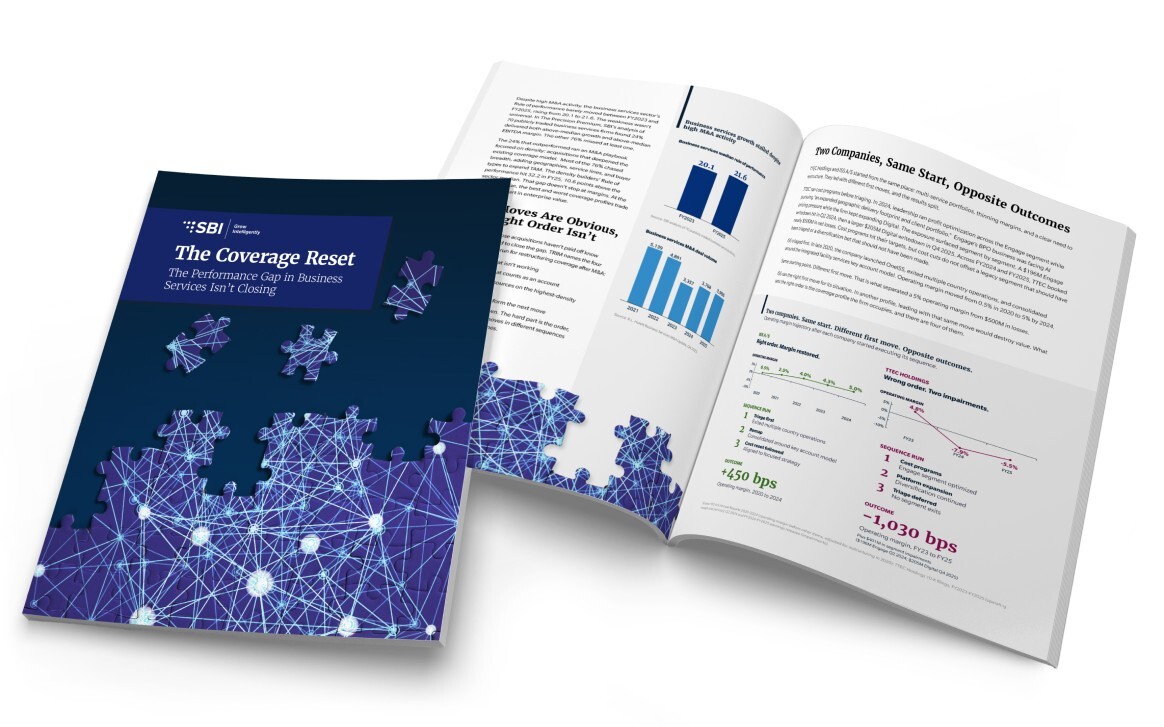
M&A activity in the business services sector remains historically high, yet actual financial returns fail to follow transaction volume. Business services firms often know which moves to make after an M&A deal. The problem is deciding which one comes first. Across 70 publicly traded firms, the median Rule of performance increased only from 20.1 in FY2023 to 21.6 in FY2025. Only 24% produced both above-median growth and above-median EBITDA margin. The stronger group reached a Rule of performance of 32.2, while many of the remaining firms added breadth without enough operating density to support it.
The Mandate: Sequence Before Scale
Success starts with the right sequence. Triage, Remap, Intensify, and Measure are all essential moves, but if done in the wrong order, they can work against each other. Focusing on costs won’t fix a portfolio that needs streamlining, and adding sales capacity won’t help if account economics are weak. The key is not just deciding what to do but knowing where to begin.
Identify the Coverage Profile
Finding the right starting point depends on two questions. First, can your current infrastructure support the new segment? Second, do the buyer, pitch, and sales approach still fit? How you answer will define your company’s coverage profile, and each profile requires the same four moves, but in a different sequence.
Run the TRIM Sequence
The TRIM framework guides leaders to the right starting point for their company’s profile. Compounding Zone firms will see results by Intensifying first, while Stretch firms should begin with Remapping. Scaling Wall firms benefit from Measuring, and Full Exposure firms need to start with Triage. The sequence is important because each step sets up the next. When the order is off, resources like cost, capital, and field capacity may be wasted on a model that cannot deliver results.
Reset the First 100 Days
The first 100 days are crucial for establishing the right sequence and halting any work that runs counter to it. Within 30 days, leadership should agree on the coverage profile and identify the first move. By 60 days, resources and executive focus need to support that move. By day 100, the first initiative should be funded, measurement should have begun, and the next step should be scheduled.
Close the Enterprise Value Gap
At $300 million in revenue, the top-quartile profile in the report produces an estimated enterprise value of $1.08 billion. The bottom-quartile profile produces roughly $142 million.
That is an estimated gap of about $940 million, or 7.6x enterprise value, at the same revenue scale. Misclassifying the coverage profile risks funding the wrong sequence of actions and sustaining the very performance gap the plan aims to close.