

67% of SaaS companies ignore value-based pricing, according to our latest 2024 State of SaaS report and research. They invest heavily in competitor-led or cost-plus pricing - and miss out on revenue opportunities as a result.
From gaining a competitive advantage to strengthening unit economics, value-based pricing is a huge untapped growth lever. To pull it, you need to build an effective pricing strategy that aligns your company and business goals.
Value-Based Pricing Strategy in 5 Steps
1. Assemble the Right Pricing Team
Put together an in-house pricing team with people from four key departments to contribute to your value-based pricing strategy.
- Marketing - For input on your buyer personas, positioning, messaging and communicating pricing to customers.
- Sales - For input on conversion, sales tactics, sales forecasts and key customer objections.
- Customer Success - For input on existing customer value and upsell opportunities.
- Product - For input on features, product usage, and product bundling.
Executive-level sponsorship and oversight is critical to driving change. A C-Level leader, typically the CFO or COO, should act as the final decision-maker.
2. Conduct an Internal Pricing Audit
To define the goals and objectives of your value-based pricing strategy, the pricing team needs to gather baseline data on your existing pricing structure and processes.
An internal pricing audit assess five core business aspects that impact pricing.
- Acquisition - Examine the process of gaining new customers and how much it costs, Customer Acquisition Cost or "CAC".
- Monetization - Determine which revenue metrics to focus your pricing on - i.e. lifetime value (LTV), the average rate per user (ARPU) or payback period.
- Retention - Establish why customers are staying and churning.
- Pricing Model - Consider the set-up and purpose of your current pricing model - i.e. do you have all-inclusive pricing or tiers aimed to maximize monetization?
- Discounts - Reflect on the current discounts you offer and the impact of these incentives.
By drawing on historical data, interviewing internal teams and asking each pricing team member to drill down into their core competence, this internal pricing audit will reveal the existing weaknesses that are preventing growth and how better pricing can solve them before you analyze your customers and external market.

3. Analyze Customer Value
Only your customers can tell you the real value of your product. Your pricing team must ask the right questions to the right buyer personas to uncover their perceived value and willingness to pay.
- Verify your ideal customer profile (ICP). Look at your total addressable market (TAM), work out your best-fit companies and segment them according to their size, industry, and pain points.
- Identify your key buyer personas. Determine which roles and personas at your ICP are most likely to use your product and why, as well as who makes the ultimate buying decision.
- Find out what they value. Reach out to these personas directly to gather data on their product usage behavior and what features, services and outcomes they value the most (and least) from your product.
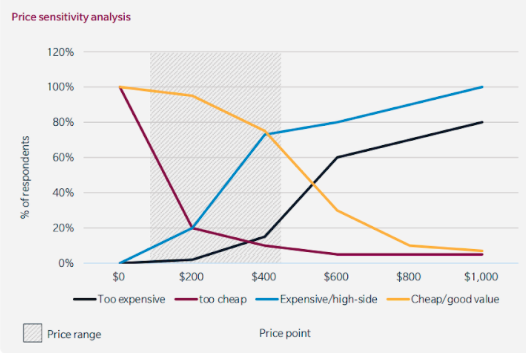
- Calculate willingness to pay (WTP) based on value. Use Van Westendorp’s Price Sensitivity Meter to find out their WTP. Ask each buyer persona at what price they would consider the product:
- So expensive they would not buy it? (Too expensive)
- So cheap they feel the quality couldn’t be very good? (Too cheap)
- Is starting to get expensive, so they would have to give some thought to buying it? (Expensive/High Side)
- To be a bargain—a great buy for the money? (Cheap/Good Value)
The optimal price lies in the middle price range.
The optimal price lies in the middle price range
4. Calculate and Package the Optimal Pricing
Your price points should lie in the optimal WTP price range. But you also need to quantify other elements of the buyer persona before finalizing your pricing packages.
Customer acquisition costs (CAC) must be taken into account, as well as the lifetime value (LTV) of each target buyer to test sustainability.
For example, if one buyer persona is only willing to pay $10/month, but costs $500 to acquire, your payback period is 4+ years.
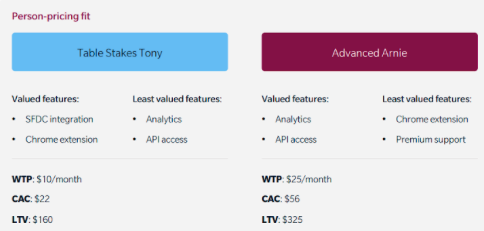
After quantifying your buying personas, it’s time to choose a pricing model and tier your packages correctly:
- Offer packages and price points that precisely meets customers' value and maximizes revenue.
- Segment your pricing tiers by buyer personas - ranging from the smallest WTP to the highest WTP.
- Consider what product features, services or outcomes each persona profile values and make these instantly clear on the pricing tiers (and landing page).
You need to price around the ‘value metric.’ For example, if all customers love your widgets, your pricing tiers should focus on how many widgets customers can use until they have to upgrade their plan. This way, larger companies pay more than smaller companies (and you maximize revenue).
Make sure your value metric is clear and easy to grasp, so prospects immediately understand what they would be paying for and where they fit in your packaging.
5. Test, Test, Test
At this point, all your pricing team’s detailed analysis and hard work has produced a set of theories. You now need to test these hypotheses to see if they work in reality.
- Test incrementally. Use data-driven experiments to validate (or invalidate) individual hypotheses at a granular level, so you can drill down into the best possible pricing solutions (but don't try and test everything at the same time).
- Test with minimal effort. Use minimum viable tests rather than large surveys or samples that take time and effort.
- Don't publicly A/B test. The sample size of an A/B test will likely lead to insignificant results and you run the risk of damaging the relationship with the customer that pays a higher price.
Implement Your Value-Based Pricing (But Avoid the Pitfalls)
Et voilà. You now have an effective value-based pricing strategy that will help you grow revenue 4x more than acquisition strategies and 2x more retention efforts.
But remember: when putting your new pricing into practice, steer clear of the three most common pitfalls.
- Not communicating with customers. Ensure all customers understand the rationale behind your new value-based pricing or they’re more likely to push back.
- Not aligning employees. Ensure all departments understand the new pricing, so Sales can hone their sales pitches, Marketing can adapt external messaging and Product can focus on features that customers actually value.
- Not changing pricing regularly. Ensure you re-evaluate your pricing approach and make changes every six months (or whenever your product changes), so it remains fit for purpose.
