

The GTM stack has been shrinking for years. What used to be 12 to 18 point tools is now collapsing into four to six platforms, and the next stage looks even tighter, with two to four platforms and an agent layer on top.
Three forces are pushing that change along. AI is taking over work that used to live in point tools. Platforms are folding acquisitions into single offerings. And a fuller data layer is starting to matter more than the CRM itself.
That matters because the CRM was built for what a person types into it. It was never built to hold the signals agents need, like usage, tickets, and transactions, which already live in the systems that produce them.
Last July, we argued that net revenue retention is the exit multiple a sponsor can actually influence, and that the real lever is reading account behavior, not account sentiment.
What Is the Account Brain, and Why It Matters
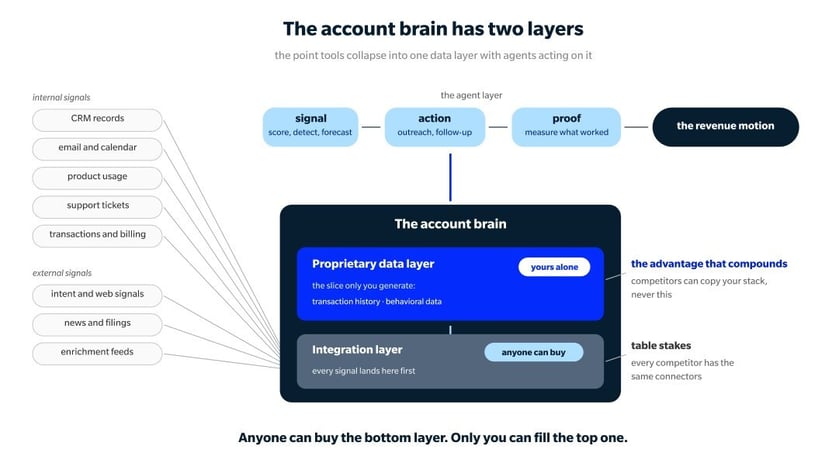
The two layers
Most portfolio companies can buy the integration layer. It is table stakes now, and it is where every signal lands first. CRM records, conversation data, product usage, support tickets, and enrichment feeds all flow there.
According to SBI’s Q4 2025 survey, 30% of CEOs said data quality and integration were their biggest barrier to AI adoption in GTM. That layer matters, but it is not the moat.
The real advantage sits in the proprietary data layer, built from a company’s own transaction history and behavioral data. No vendor sells that layer. A company has to capture it from the work it is already doing.
What the proprietary layer is worth
The QuadSci research puts real numbers behind that layer. It found that usage explains 80% of renewal and expansion decisions. It also found that usage cohorts predict retention 12 months out with 90% accuracy. Companies that get the signal to the account team in time can see an average 5% lift in NRR.
That signal usually breaks in two places. First, usage data is noisy when it stands alone. Second, even when the signal is real, it often reaches the account team too late to act on it. The value is not just in collecting the data. It is in making it usable at the right moment.
Proof beyond software
This idea is not unique to software.
Rolls-Royce turned engine telemetry into TotalCare, a per-flying-hour revenue model that now out-earns manufacturing in its services business. ADP turned payroll data from 26 million workers into a national benchmarking business.
Both examples point to the same truth. A company’s position in the market generates data that no one else can replicate, and that data can be turned into economics.
Inside the agent layer
The account brain is the chain that connects signal, action, and proof.
That chain shows up across a revenue motion in six parts.
-
Find demand
-
Win the deal
-
Trust the forecast
-
Keep and grow
-
Make reps better
-
Foundation
Most companies already own individual links in the chain. They may have a churn model, call intelligence, or a forecasting tool. What they usually do not have is the connection between them. That assembled chain is the one thing no vendor sells.
Sponsor Takeaway
Run a quick test against every asset in a portfolio: list what a competitor could replicate by buying the same tool stack. If that list covers most of what the company does, the proprietary layer is thin or missing, and closing that gap belongs in this quarter's value creation plan.
Next Steps for Operators
Fill the proprietary layer. Fast.
-
Start with the signals the business already creates and loses today: the calls not mined, the usage not pooled, the win-loss reasons not logged.
-
From there, capture on the motion already running. Conversation data is the fastest place to start. The renewal motion proves the model fastest.
-
On every agent, make the build-or-buy call. Build only what touches pricing or proprietary data. Buy or partner for the rest.
The scoreboard is simple: revenue up, cost down. If the right signal reaches the account team in time, revenue moves. If one system replaces three, cost falls.
And lock the legal rights now, not later. They are easier to secure up front than to retrofit after the system is live.
Learn how SBI Wayforge helps portfolio companies build the layer their competitors can't buy.
Contact pe@sbigrowth.com.