

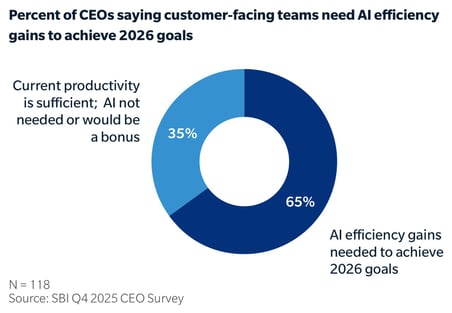
Go-to-market AI strategies are largely failing to produce tangible financial results. Currently, only 18% of sales organizations report high ROI from these tools. This places sales near the bottom of all business functions, trailing IT at 39% and marketing at 37%. Despite this underperformance, 65% of GTM leaders have already staked their 2026 growth plans entirely on AI productivity gains.
This widespread disconnect is caused by the "Automation Illusion", which is the false belief that productivity gains from speed inherently drive commercial efficiency and growth. Automating an already bad process simply amplifies its underlying cost. Commercial outcomes rely on activity accuracy rather than volume, and the true gap between average performers and market winners is a matter of aim rather than raw effort.
This blog will explore the three categories of AI investment and provide a strategic framework for building the analytical infrastructure your go-to-market team actually needs to succeed.
Key Takeaways
-
Just 18% of sales organizations report high returns from their artificial intelligence investments, but 65% of go-to-market leaders still stake their upcoming growth plans entirely on these tools
-
Leaders often expect speed to drive revenue, but automating an already flawed process simply amplifies its overall cost
-
Basic frontline productivity tools offer almost no competitive separation, and outperforming companies instead secure massive impact multipliers through advanced predictive analytics
-
Organizations should deploy forecasting tools against high-value segments first; this initial step establishes a firm targeting layer to direct all future enablement efforts
-
You must position this analytical framework as a core business infrastructure to your executive board, for this deliberate sequencing ultimately builds a highly predictable growth engine
The Infrastructure: Three Categories of AI Investment
To understand exactly where the automation illusion takes hold, we must look closely at how GTM AI spending breaks down. These investments fall into three distinct categories, and each one has a fundamentally different relationship to actual commercial outcomes.
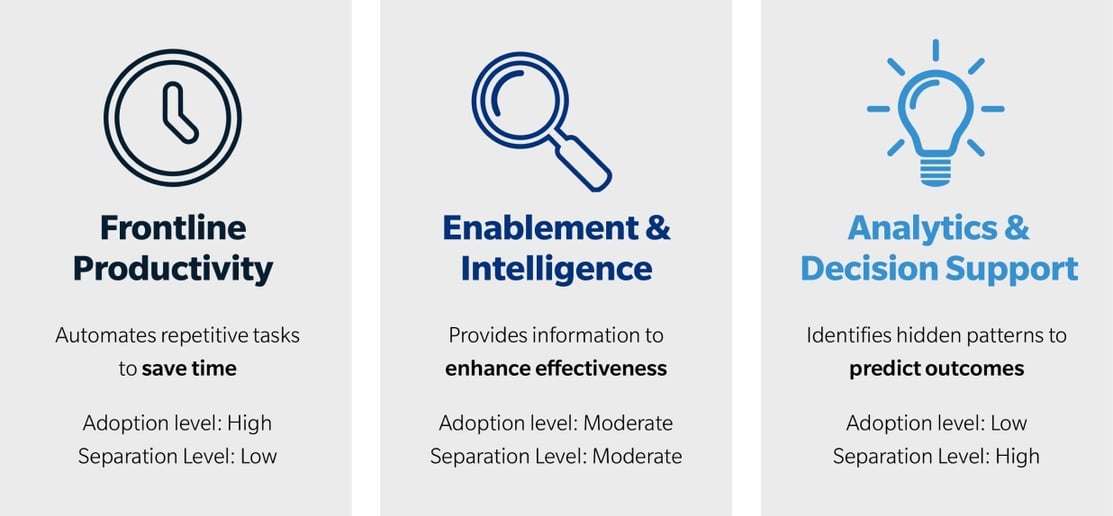
1. Frontline productivity (high adoption, low separation)
This category automates repetitive tasks to save time, and it includes tools for meeting summaries, email generation, and chatbots. Vendors heavily pitch these tools because they demo well and present easily modeled productivity gains. However, they create almost no competitive advantage. Outperforming companies only use these tools slightly more than average teams, showing multipliers between 1.2x and 1.6x. Time saved simply feels like progress, but it only improves actual outcomes when teams spend that saved time on the right activities. For instance, automated meeting summaries will never change which meetings actually matter.
2. Enablement & intelligence (moderate adoption, moderate separation)
This investment layer provides targeted information to enhance overall team effectiveness. It includes vital capabilities like account research, competitive intelligence gathering, and proposal generation. These tools begin to create real distance between competitors, and outperformers show a 1.7x multiplier for account research and a 1.8x multiplier for competitive intelligence. These platforms change what sellers actually know rather than just how fast they move.
3. Analytics & decision support (low adoption, high separation)
This is the crucial impact zone that identifies hidden patterns to predict future business outcomes. This category determines which activities teams should pursue, utilizing capabilities like forecasting, pipeline prediction, and customer churn prediction. While overall adoption remains very low, this is where competitive differentiation truly peaks. Forecasting delivers a 2.1x multiplier for outperformers, and churn prediction offers a massive 2.9x multiplier. Despite this overwhelming statistical advantage, only 9% of all GTM teams currently deploy customer churn prediction.
The Framework: A 3-Step Sequencing Discipline
Breaking the automation illusion requires a strict sequencing discipline. Most GTM organizations strongly resist this approach, but it remains strictly essential for building true competitive separation.
-
Start with analytics (the targeting layer)
Before making any new productivity investment, you must deploy forecasting and churn prediction against your highest-value segments. This critical first step creates a targeting layer that dictates the success of all future deployments. Leaders should expect six months to operationalize these systems and nine months to demonstrate measurable accuracy gains. - Let analytics direct your roadmap
Predictive insights must determine exactly where your productivity and enablement efforts go next. For example, you should immediately prioritize customer success tools if your predictive churn models identify CS response time as a primary binding constraint. Analytics identify which specific problems are actually worth solving, and downstream tools simply solve those exact problems faster. - Scale productivity last
Organizations should implement additional tools strictly to accelerate the execution of validated activities. Productivity effectively amplifies your desired outcomes when deployed in this exact sequence. Conversely, scaling productivity first simply amplifies waste.
Managing Stakeholder and Board Expectations
This proper sequence takes time to execute. GTM leaders will inevitably face pressure from vendors pushing quick wins, and executive boards will naturally demand visible activity. You can manage these expectations by framing the initiative correctly during your first two quarters.
- Position as infrastructure: Tell your executive board that you are building the core infrastructure that makes every other AI investment actually work. Boards generally understand infrastructure investments when leaders position them correctly
- Report on leading indicators: You should initially report on data coverage, prediction confidence, and early model outputs rather than immediate revenue figures
- Reframe existing tools: Most organizations have already purchased basic productivity tools, and this is not wasted spend. You can reframe these existing investments as a powerful accelerant that is simply waiting for a validated targeting layer. Teams must stop measuring basic activity metrics and start measuring execution against these newly analytics-validated priorities
Securing Your Competitive Advantage
Activity volume alone no longer drives commercial outcomes. Excellence requires a strict focus on activity accuracy to ensure every sales and marketing effort hits the right target. Achieving predictable revenue growth requires building a mature analytics infrastructure, and this foundation makes your GTM investments highly capital-efficient. This level of performance requires companies to properly sequence their AI initiatives and align new productivity tools with a validated targeting layer. Our latest research provides the exact framework to build this predictable growth engine and escape the automation illusion.