

Bigger TAM, Worse Results: The Coverage Trap Killing Revenue Growth
On paper, things looked promising. A billion-dollar enterprise planning software provider with a CRM packed with about 150,000 accounts across three global regions. On the ground, growth was slowing, and the company found itself spending more to grow less.
The signs were hard to miss. Mid-market accounts were consuming field resources that should have been focused on strategic accounts. Territory potential varied by more than 50% within the same commercial pods. Some reps carried books worth three times the value of peers with the same quota. Sales, customer success, and marketing each read the data differently, set different priorities, and eventually stopped trusting the numbers.
The company’s GTM model was breaking. Because it has unknowingly fallen into the TAM trap.
The Data Behind the TAM Trap
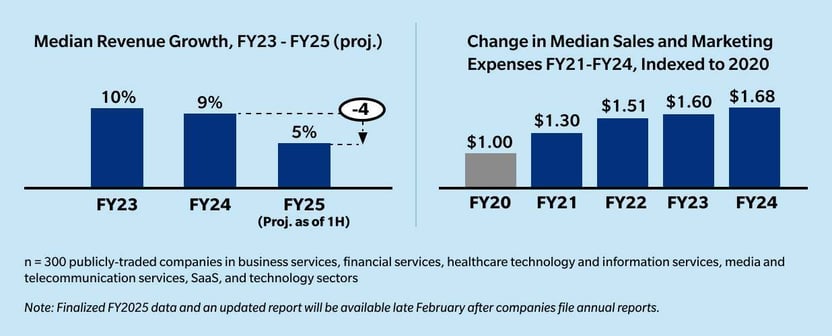
Our analysis of revenue growth rates and GTM costs across 300 publicly traded companies points to the same conclusion. Median revenue growth fell from 10% in fiscal year 2023 (FY23) to a projected 5% in fiscal year 2025 (FY25). Over a similar period, GTM spend rose 68%, increasing from an indexed $1.00 in 2020 to $1.68 in 2024.
Growth was cut in half while costs kept rising.
This is not a temporary slowdown caused by a soft market. It is what happens when companies expand TAM on paper without changing how they win in the field.
What happens when a company that once targeted 10,000 accounts in a focused vertical tries to cover 50,000 accounts across five verticals? Sure, its TAM is now five times larger. But the company can still only win in segments that understand its value proposition and have buyers with the authority, urgency, and budget to say yes.
Everything else is noise dressed up as opportunity in a spreadsheet.
Why Larger TAMs Weaken GTM Models
When companies chase a larger TAM without redesigning the GTM model, the result is not more opportunity. It is four predictable problems.
- Positioning gets diluted
Buyers may have known you for workforce planning. Now you also sell inventory optimization. The market will not connect those dots for you, so reps are left trying to tell a story that feels broader, but less coherent. Sales cycles get longer, not because the product is worse, but because the narrative is harder to understand and trust. - Selling becomes product-out
Leadership rolls out SPIFs and adjusts comp plans to push new offerings. Reps start pitching what headquarters wants sold, not what the customer actually needs. Focused competitors win because they have less to explain, less to justify, and a clearer story. - Coverage complexity increases
A company that once sold to finance now has to engage technology, operations, and HR leaders in the same account. Territories may still look balanced on paper, but in practice, each one contains more buyer groups, more stakeholder paths, and more opportunities for deals to stall. Even if headcount stays flat, productivity per rep falls. - Churn rises
To win in unfamiliar segments, sellers stretch use cases and improvise value propositions. Customer success inherits the gap between what was promised and what can be delivered quickly. Customers struggle to realize value, and renewals become harder and less profitable.
Taken together, these four issues create the worst outcomes. The team spends time covering accounts it is unlikely to win. Marketing generates demand in segments where the company has no real advantage. The strategy meant to accelerate growth becomes the thing that slows it down.
How to Escape the TAM Trap
Chasing a larger TAM is no longer a strategy. It is a tax on capital.
Over the next three years, the winners will not be the companies with the widest coverage, but those with the highest coverage intensity. These companies will know where each GTM dollar, rep hour, and campaign earns a return, and they will keep funding those paths relentlessly.
Our new research report, The TAM Trap: Why Chasing Market Size Is Destroying Your GTM Efficiency, will show you how to make the shift. You’ll learn how to identify high-yield microsegments, use the ROAD framework to allocate coverage like capital, and redeploy GTM resources toward the areas that generate outsized returns.
Download your copy today.
Read Research Report