

Most GTM teams believe they are implementing AI. The results suggest they are not. Adoption is high, and activity is increasing, yet commercial outcomes remain largely unchanged. The assumption is that speed will translate into efficiency. It does not. This is the automation illusion, where faster execution creates the appearance of progress without improving performance. When AI is layered onto already inefficient, volume-based systems, it amplifies them. More emails are sent, more calls are made, and more data is processed, but the underlying issue remains the same. The system is still misaligned.
What changes in high-performing teams is not the level of automation but where and how it is applied. Instead of scaling activity, the system narrows its focus by identifying where real buying signals exist and directing effort accordingly. The model shifts away from more tools, more output, and more headcount toward precision, signal-driven execution, and system leverage. The difference is not more automation. It is a system that knows where to act and improves that decision over time.
Key Takeaways
- Automating a flawed GTM system does not improve performance, but it accelerates inefficiency
- The shift is from volume to precision, where teams focus only on accounts that are actually in market
- Predictive systems outperform reactive workflows by surfacing churn risk and expansion opportunities early
- Growth is no longer tied to headcount, and system-driven execution allows smaller teams to outperform larger ones
- Competitive advantage comes from a system built on proprietary data that improves with every interaction
The Shift from Volume to Precision
Most outbound motions are still built on volume. SDR teams run high-frequency sequences across large account lists because conversion rates are low, and the only way to compensate is through more activity.
This drives headcount expansion and steadily increases CAC, but it does not resolve the underlying issue. The system is designed to generate effort, not outcomes, so scaling it only produces more noise.
High-performing teams operate on a different model. The system identifies the small subset of accounts that are actually in-market and builds the full account context before any engagement occurs.
Sellers no longer rely on guesswork. They engage with a clear point of view, targeting fewer accounts with higher intent. As a result, smaller and more senior teams consistently outperform larger ones built on volume. This is where activity-based GTM breaks down. Accuracy matters more than volume.
Winning teams do not do more outreach. They do less, with far higher intent.
Retention Moves from Lagging to Leading
Retention is still managed as a lagging process. Most teams rely on manual health scoring, pulling together fragmented signals to assess account risk. By the time churn becomes visible, it is often at the point of renewal, when the outcome is already difficult to change. The system detects problems too late because it is built to look backward rather than forward.
In a system-driven model, retention becomes predictive. Early churn signals are surfaced automatically through shifts in behavior, engagement, and sentiment, allowing teams to intervene before risk compounds. CSMs no longer need to manually assess every account. They focus on the subset that requires action, which allows them to scale across a larger portfolio without sacrificing effectiveness. This is where analytics and prediction begin to show their impact in practice, driving materially better outcomes than activity alone. Retention stops being reactive and becomes an early-warning system.
Expansion Becomes System-Sourced, Not Rep-Driven
Expansion is still largely rep-driven. Teams rely on manual whitespace analysis to identify opportunities, which means discovery occurs late and is often inconsistent.
As new products are introduced, the default response is to add overlay roles to support the motion. This increases cost and slows execution, but does not guarantee better coverage. The system depends on individual effort, so opportunities are missed as often as they are found.
In high-performing teams, expansion is system-sourced. The install base is continuously scanned to identify accounts with the highest likelihood to expand, and relevant context is assembled before any engagement begins. Sellers enter conversations with a clear understanding of where value exists, rather than trying to uncover it in real time. This shifts expansion from human discovery to system discovery and removes the need to scale headcount alongside each new product. Pipeline is no longer created through effort alone. It is surfaced by the system, enabling growth that is no longer constrained by the size of the team.
The Headcount Trap and How It Breaks
Most GTM organizations still scale headcount alongside revenue. More pipeline requires more sellers, and more accounts require more coverage.
At the same time, research and synthesis sit inside every role, which means each incremental hire carries the same overhead. This creates a linear growth model where cost rises in direct proportion to output, limiting efficiency gains over time.
That model breaks when those functions move into the system. Research, signal detection, and context generation are centralized, allowing smaller and more senior teams to operate with greater precision. Execution roles become more focused, while new roles emerge to build and maintain the underlying system. This mirrors the broader shift in SaaS, where AI is breaking the link between output and headcount . The same structural change is now happening inside GTM.
Growth is no longer a hiring problem. It is a system design problem.
The System Behind It All: The Account Brain
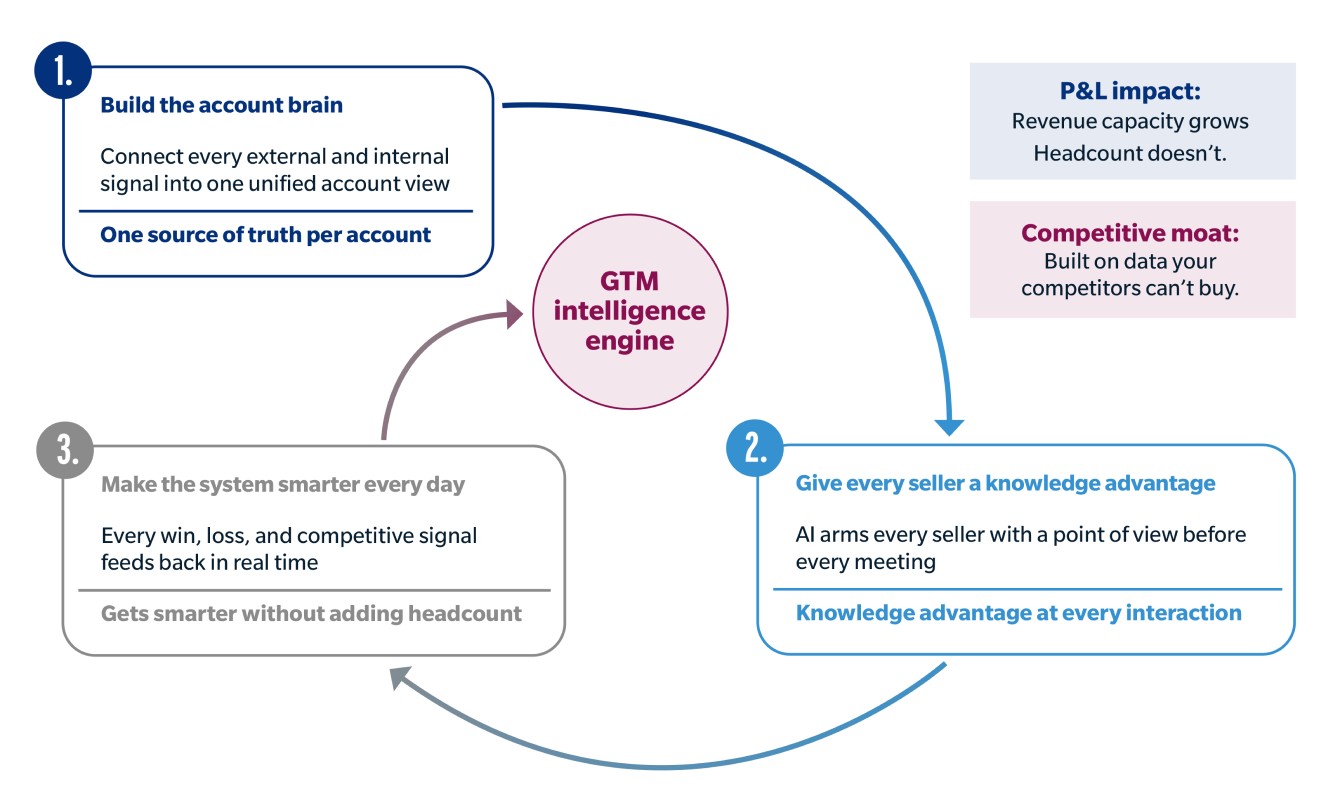
None of these shifts happens without a unified system underneath them. Most organizations already have the required data, but it sits across disconnected systems and functions.
As a result, signals remain fragmented, and decisions are made without full context. The Account Brain consolidates these inputs into a single system that remembers every interaction, continuously learns from new information, and turns signals into actions. It brings together external inputs such as firmographics, intent signals, market shifts, and buying network changes alongside internal data from CRM activity, contracts, usage patterns, call transcripts, and customer experience.
This system stores information and operationalizes it by determining who to engage in outbound efforts, providing a point of view before every sales conversation, surfacing churn risks for customer success, and identifying expansion opportunities across the account base. This is the foundational layer that enables everything else. Without it, AI remains a set of disconnected tools that improve isolated tasks but fail to change outcomes. With it, the system compounds over time as every interaction feeds back into future decisions.
AI does not create the advantage. Proprietary context does.
Why Most Teams Never Get Here
Most teams start in the wrong place. They invest in productivity tools that automate emails, summarize meetings, and accelerate day-to-day execution.
These tools are easy to deploy and show immediate activity gains, which makes them appealing. But they do not address the core issue of where effort should be applied. As a result, teams move faster without improving accuracy.
High-performing organizations follow a different sequence. They begin with analytics to define what matters and where to focus. Intelligence layers on top of that foundation to provide the context needed to act effectively. Productivity is scaled last, once the system is aligned. Most teams invert this sequence, which is what creates the automation illusion. They optimize execution before fixing targeting, and the system becomes more efficient at producing the wrong outcomes. If you automate before you aim, you just miss faster.
From Tools to a Compounding System
Most teams focus on adding capabilities, but the advantage comes from how those capabilities are connected and how the system improves over time. When built correctly, each interaction feeds future decisions, and performance no longer resets at the start of each quarter.
The transformation is structural. Outbound moves from volume to precision. Retention shifts from reactive to predictive. Expansion becomes system-sourced instead of manually driven. And, headcount no longer scales linearly and is replaced by leverage. Six months in, the system supports your team. Then, twelve months in, it begins to outlearn your competitors.
Learn How Leading GTM Teams Are Building Their Account Brain