

For two decades, SaaS growth followed a predictable sequence. Customer acquisition drove internal headcount, and that hiring directly translated into seat growth and vendor revenue. AI has officially severed this chain.
Currently, 78% of SaaS companies continue to use seat-based pricing, making it the primary value metric for 47% of the industry. The ultimate irony of the AI era is that a highly effective product directly reduces customers' need for human operators, which, in turn, causes severe commercial contraction for the vendor. This guide will detail the six specific software archetypes and show you exactly how to restructure your commercial model to survive this transition.
Key Takeaways
- AI directly reduces necessary human activity, and this operational efficiency immediately breaks traditional seat-based pricing models
- The software market clusters into six specific archetypes and three primary threat pairs. Leaders must identify their exact position to successfully realign their commercial strategies
- Growth velocity no longer guarantees survival in the modern enterprise market. Organizations must build growth durability by shifting revenue models toward generated artifacts, data intelligence, or protected risk surfaces
The Six Archetypes: Identifying Your Threat Pair
All SaaS companies linking value to headcount will inevitably face a commercial decline. Understanding your specific archetype is exactly what separates the organizations that fail from those that survive and thrive. The broader SaaS landscape breaks down into six distinct business archetypes, and these specific models cluster into three defined threat pairs.
Your underlying commercial model dictates your exact strategic response. Each archetype faces a unique path forward, and executive leaders must identify their specific threat pair to navigate this transition effectively.
The Exposed (Output Generators and Workflow Coordinators)
These platforms must shift their core product focus from enabling human users to actively replacing them, and their underlying pricing models must follow.
-
The threat: The primary threat is human replacement. AI tools produce the work product directly and handle complex workflows via API calls
-
The evidence: Developer tooling has already experienced 15 to 30 percent seat contraction at the enterprise level as individual productivity surges. Customers extract more value while aggressively cutting the seat counts that fund the software
-
Red flag telemetry: Organizations must watch for a rising artifact-to-seat ratio or an API-to-UI traffic divergence. This divergence occurs when the platform produces more tangible assets or background actions while human logins steadily decline
-
The pivot: Leaders must shift pricing away from software access to monetize the actual artifact produced or the automated resolution. Revenue must connect directly to the code merged, the campaigns launched, or the ticket resolved
The Eroding (Systems of Record and Vertical Specialists)
The competitive commercial moat for these specific platforms is no longer the user interface or the specialized features.
-
The threat: The core interface is becoming optional while the underlying data layer becomes significantly more valuable. Users increasingly bypass the native dashboard to query enterprise data using external AI agents, and they use generic AI to substitute niche industry features
-
Red flag telemetry: Companies should track the share of external query volume growing against traditional seat-originated queries. They must also monitor the feature substitution rate when customers begin applying generic AI tools to industry-specific workflows
-
The challenge: Vendors must renegotiate legacy master service agreements and data rights to legally monetize the data layer instead of the dashboard. Without establishing explicit privacy boundaries and customer opt-in frameworks, the proprietary data moat remains an illusion
-
The pivot: The commercial model must charge for intelligence and data integrity rather than standard interface access. Organizations should implement specific access fees for external agents querying proprietary datasets
The Squeezed (Security, Compliance, and Data Infrastructure)
The broader enterprise market is structurally reorganizing around these companies in ways that fundamentally compress margins and eliminate their standalone position.
-
The threat: Chief Financial Officers are aggressively reducing vendor counts to consolidate software stacks, and spiking AI compute usage drives up internal costs for data infrastructure providers simultaneously
-
The margin crisis: Traditional software gross margins in the 80% range face a severe risk of dropping toward 40%
-
Red flag telemetry: Teams must monitor the non-human identity ratio and the gross margin per workload type. Securing more automated agents than human employees exposes a fundamental misalignment in the underlying risk-to-revenue calculation
-
The pivot: Security vendors must base pricing on the total AI footprint protected rather than human employee headcount. Data platforms should deploy tiered pricing structured by specific workload types and actively segment their margin management
The "Valuation Expander" Gap
Most leaders fail to recognize that optimizing a flawed pricing model simply accelerates commercial decline. Moving into the Valuation Expander quadrant requires a deliberate structural shift to protect long-term enterprise value.
The CEO disconnect
Today, 87% of software CEOs classify themselves as actively optimizing or maximizing their existing commercial models. This heavy focus on baseline optimization prevents necessary structural evolution, leaving companies completely vulnerable to the shifting landscape.
The elite 5%
Only 5% of leaders have successfully moved into the Valuation Expander quadrant. Each of the six archetypes faces a different path into this quadrant, and the final destination remains exactly the same. These elite leaders willingly accept near-term revenue compression to deliberately build long-term enterprise value.
The lesson from history
This massive market shift directly mirrors the historical transition from on-premise to cloud software. Proactive companies secured permanent market advantages during that specific window. Delayed action dictates a forced transition under highly unfavorable conditions later.
Navigating the Transition: "Swallowing the Fish 2.0"
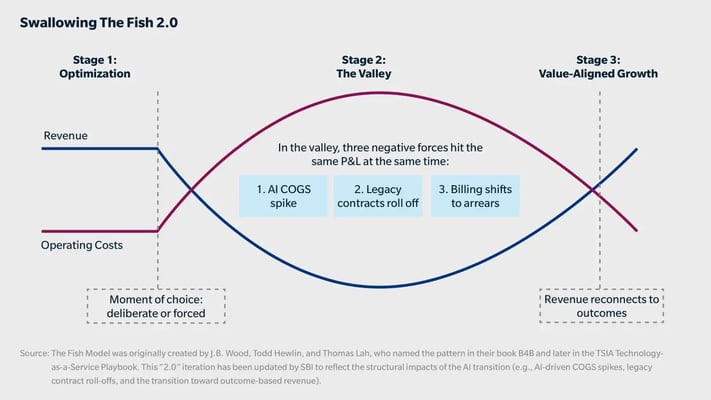
Transitioning away from seat-based pricing forces organizations to swallow the fish once again, creating a dangerous financial trough that executive leaders must carefully manage.
Entering the valley
All SaaS companies that link value to headcount will inevitably enter this operational valley. Vendors face a severe triple threat to the profit and loss statement during this specific transition phase. AI computing costs spike rapidly, legacy contracts roll off the books, and billing systematically shifts to arrears.
The hybrid solution
Successful companies explicitly avoid pure consumption models because unpredictable revenue terrifies corporate boards. These organizations implement a two-part hybrid pricing model to stabilize baseline operations and capture new upside simultaneously.
-
The platform fee: This foundational baseline creates a predictable and recurring revenue stream. It secures the annual recurring revenue floor reliably
-
The value fee: This component establishes a dynamic variable charge. It ties revenue directly to AI-generated outcomes or automated resolutions
From Growth Velocity to Growth Durability
Growth velocity built SaaS, and growth durability will save it.
Fast growth no longer guarantees enterprise success in the modern market, as companies need a resilient commercial model that withstands massive customer productivity gains. The recent market contraction served as a definitive warning to the industry. Leaders must build the core infrastructure for outcome attribution and workflow-level metering today, as the traditional seat-based model is already evaporating.